


In Chainlink’s latest 2.0 upgrade to the Cross-Chain Interoperability Protocol (CCIP), Succinct has introduced a zero-knowledge cryptography Cross-Chain Verifier (CCV). This offering will support high-value transfers from Ethereum to any other EVM chain. Any party, from asset issuers to banks, can add Succinct’s CCV to require a ZK proof of Ethereum’s finality before funds move.
This is a game-changing capability for institutions as they move billions of dollars onchain. CTOs and CISOs want multiple layers of security that provide defense in depth, and ZK is becoming a critical component. Succinct is ready to meet this moment, with over $18 billion TVL secured for teams like Coinbase, Polygon, and Optimism.
The new ZK module is currently available in testnet, on Chainlink CCIP’s Ethereum Sepolia to Arbitrum Sepolia lane. Stay tuned for news about the mainnet deployment.
Why institutions need proof, not trust
Institutional demand for blockchain rails has exploded in 2026. As of Q3 2026, stablecoin supply exceeded $300 billion, and adjusted transaction volume reached $8.8 trillion in the first half of 2026. Tokenized real-world assets are following close behind. Onchain RWAs issued by asset managers, banks, and payment providers hit $38 billion, up more than 400% since early 2025.
This capital is not loyal to any one chain. Issuers deploy wherever their users and liquidity are, across dozens of chains like Ethereum, Solana, Base, Polygon, Arbitrum, and Optimism. Cross-chain infrastructure is therefore a core requirement of issuance itself.
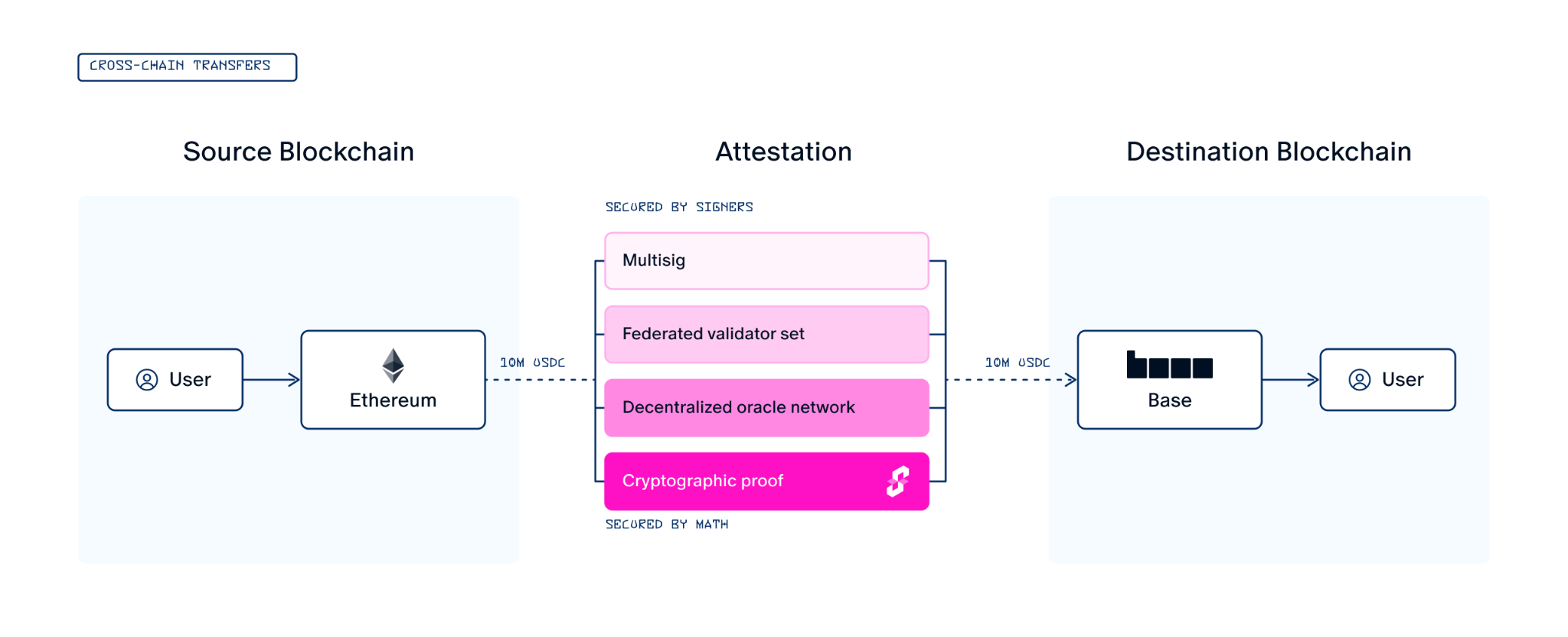
But blockchains cannot natively interact with each other. When a user moves 10 million USDC from Ethereum to Solana, Solana has no way to check that the transfer happened. Some party that sits between the chains has to attest that it did. The attestation can happen via a multisig, a federated validator set, a decentralized oracle network, or, more recently, a cryptographic proof. Each approach uses a different security model. When something breaks, the results can be catastrophic: bridge hacks have cost users more than $3.6 billion to date.
Cryptographic proofs add a new way to verify cross-chain activity. A zero-knowledge proof is a compact piece of data encoding a claim about Ethereum: that a specific block was finalized by its validators, and that the transfer is recorded in it. The destination chain can verify the proof directly, reducing the need to rely on an intermediary for that claim. In CCIP 2.0, Succinct’s ZK-based CCV can be required alongside CCIP’s default verification path, adding an independent cryptographic check. This creates defense in depth rather than relying on a single verification mechanism.
How Succinct and Chainlink work together
Chainlink CCIP securely moves assets and messages between blockchains. Every transfer travels over a “lane” that pairs a source chain and a destination chain. Before a transfer can execute on the destination chain, a verifier has to attest that it happened on the source chain.
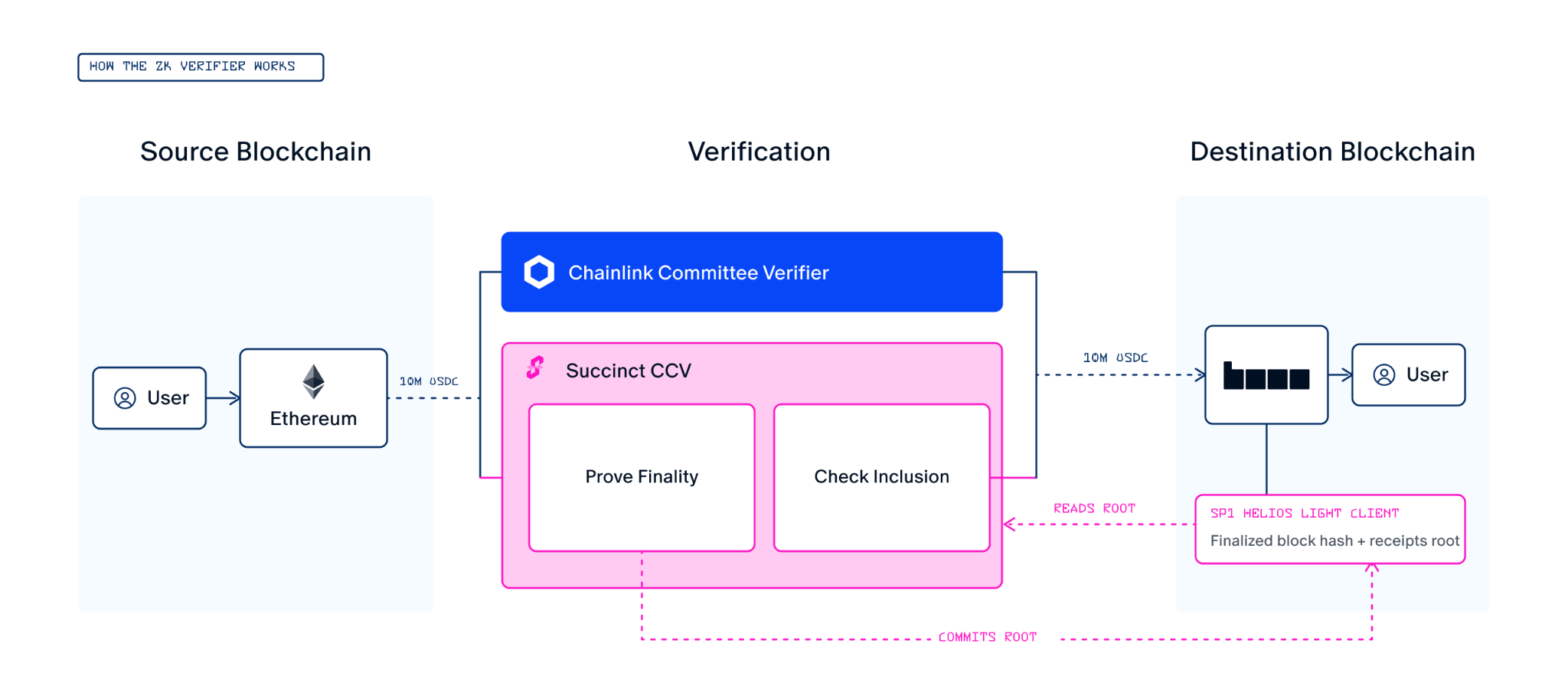
CCIP starts with a secure-by-default foundation, via Chainlink’s Committee Verifier of 16 independent, security-reviewed node operators. These sybil-resistant decentralized oracle network (DON) must reach consensus for every cross-chain transaction. CCIP 2.0 adds support for independent Cross-Chain Verifiers (CCVs) from third parties. These CCVs strengthen the security guarantees for each lane.
Succinct’s CCV is built on SP1 Helios, our zero-knowledge Ethereum light client, which adds another check to CCV-enabled transactions. SP1 Helios generates proofs that a given block was finalized under Ethereum’s consensus rules, and those proofs can be verified on any destination EVM chain. In a configuration using Succinct’s CCV, both verification paths must succeed before the transaction can execute.
Every transfer that uses Succinct’s CCV moves through three stages:
- Send. A user sends a CCIP message on a ZK-enabled lane. When the message is emitted on Ethereum, the CCIP relayer requests a ZK proof.
- Prove. The operator, an offchain service operated by Succinct, proves that Ethereum has finalized the message's block. The proof is submitted to the destination chain.
- Verification. Once the proof is verified by the default Chainlink Committee Verifier and Succinct’s CCV on the destination chain, CCIP executes the transaction by minting or releasing tokens.
This workflow provides a powerful new option for institutions and protocols who are making high-value transfers onchain. Because Succinct’s CCV provides additional verification on top of the default Chainlink Committee Verifier, the transfer is protected by multiple layers of defense. The transaction only executes when both paths are confirmed.
What’s next
The new Succinct CCV is currently in testnet on Chainlink’s Ethereum Sepolia to Arbitrum Sepolia lane. Mainnet deployment and additional lanes will follow shortly.
If you issue a token, run a protocol, or move institutional capital, reach out to experience the power of ZK security.