

On March 30th, Google Quantum AI, along with co-authors from the Ethereum Foundation, Stanford, and UC Berkeley, published a paper that accelerated the timeline for the quantum threat by decades. In it, they report a 20x reduction in the quantum resources needed to break fundamental cryptographic primitives found in certificate authorities, message encryption, VPNs, digital payments, and much of the internet’s security infrastructure.
Their findings were sensitive enough that Google withheld the quantum circuits entirely. Instead, they used SP1 to generate a zero-knowledge proof, allowing anyone to cryptographically verify the circuits exist without revealing the underlying design. The code and proofs are publicly available on GitHub for independent verification.
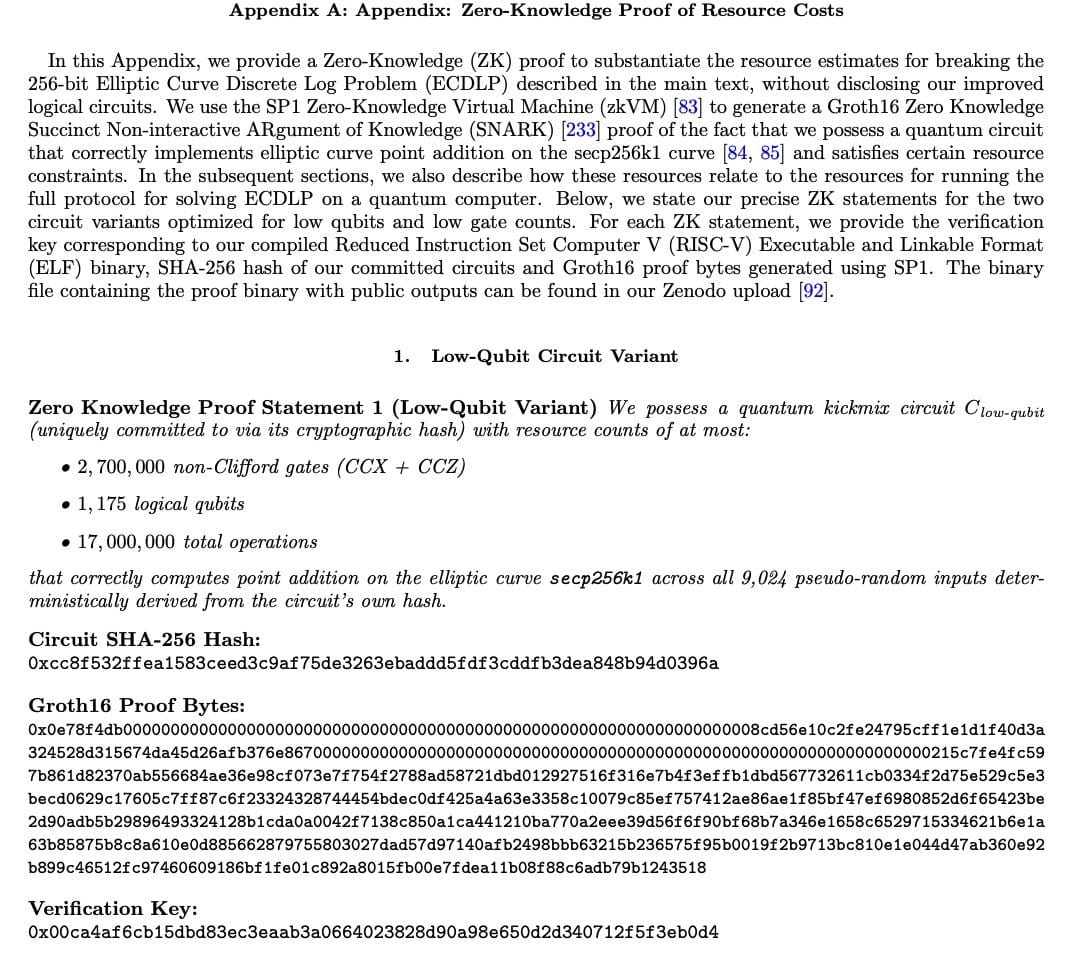
This is the first time zero-knowledge proofs have been used to responsibly disclose a novel vulnerability. Using SP1, Google established a new framework for proving the existence of a vulnerability without disclosing the details required to exploit it. This kind of disclosure wasn't practical even two years ago. Zero-knowledge proofs required bespoke circuit engineering and months of specialized development. SP1 was built to bring cryptographic verifiability to general-purpose computation, enabling Google to write zero-knowledge proofs in familiar programming languages.
As quantum threats accelerate and more research becomes too sensitive to publish in full, we expect SP1 to become essential infrastructure for responsible disclosure. If your organization is working on quantum security, vulnerability research, or responsible disclosure and wants to explore how zero-knowledge proofs can protect sensitive findings, we'd like to work together. Reach out to the Succinct team here.